

The Data Creators can leverage if the Community Owns Letterboxd
A streaming insider's take on what filmmakers should be demanding from a platform that already holds the receipts


Letterboxd has been put up for sale. And nevertheless, a coalition called Intrinsic Entertainment Collaborative has been organizing a community ownership bid, proposing a model where small donors, filmmakers, fans, and mission-driven investors pool resources and elect a Board of Governors to steward the platform alongside its existing team.
The idea is straightforward: a platform built by film lovers, for film lovers, should not end up inside another corporate portfolio where its value gets extracted and its users become a product line.
If the community ownership bid succeeds, it would be genuinely unusual in media. But the more interesting question is not whether it happens, it’s what creators do if it does.
Because Letterboxd already holds something most filmmakers have never had access to: honest, unsponsored, human-generated data about what their work actually means to the people who watched it.
I work as a product manager building first-party data products in streaming, which means I spend my days working with information the public never sees. That invisibility cuts both ways.
Studios that license their IP to platforms like Netflix or HBO Max are often operating in the dark about how their titles actually perform once they leave the lot. Streamers may send back high-level analytics on content performance, but receiving data and acting on it are two very different things.
When studios fail to translate those insights into decisions, the numbers stop being intelligence and become something closer to a vanity decoration.
Letterboxd, by contrast, is sitting on a library of organic signals that no streamer controls. Third-party services available to employers like mine scrape the internet to gauge content engagement, but Letterboxd’s edge is concentration: superfans and film connoisseurs producing user-generated lists, reviews, and ratings in one place. The audience is self-selecting, which sharpens the signal rather than diluting it.
Below I’ve used The Devil Wears Prada as an example to explain how Letterboxd can provide valuable insights to creators. While this is all theoretical and making this information open source is realistically unlikely, it’s an exercise worth exploring because it provides creators the opportunity to see how user generated content and engagement is the one asset that will never be replaced by automation.
What the Devil Wears Prada Actually Tells You
The 2006 film has a full profile on Letterboxd: watch availability, cast and creative metadata, press mentions, popular reviews, related films, and the lists where it appears.
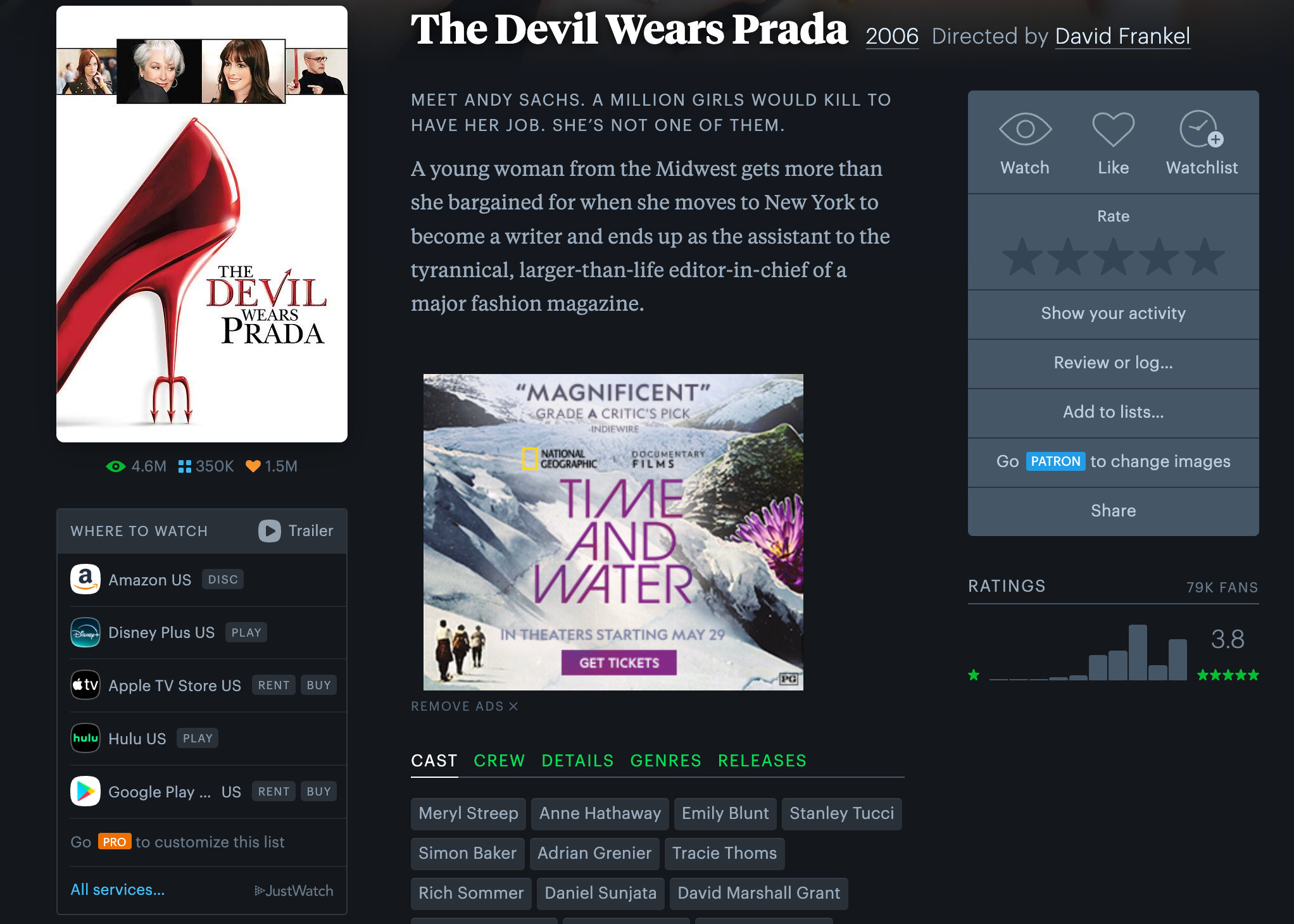
None of that is new information. What makes it interesting is the infrastructure around it. When a user adds a film to a list, saves it, likes it, or writes a review, that behavior is a data point. Not a vanity metric, but a signal about the shape of the audience.
Which lists include The Devil Wears Prada, and how engaged are the followers of those lists?
What percentage of people who encounter it through a curated list actually follow through to watch it on the platform where it is currently licensed?
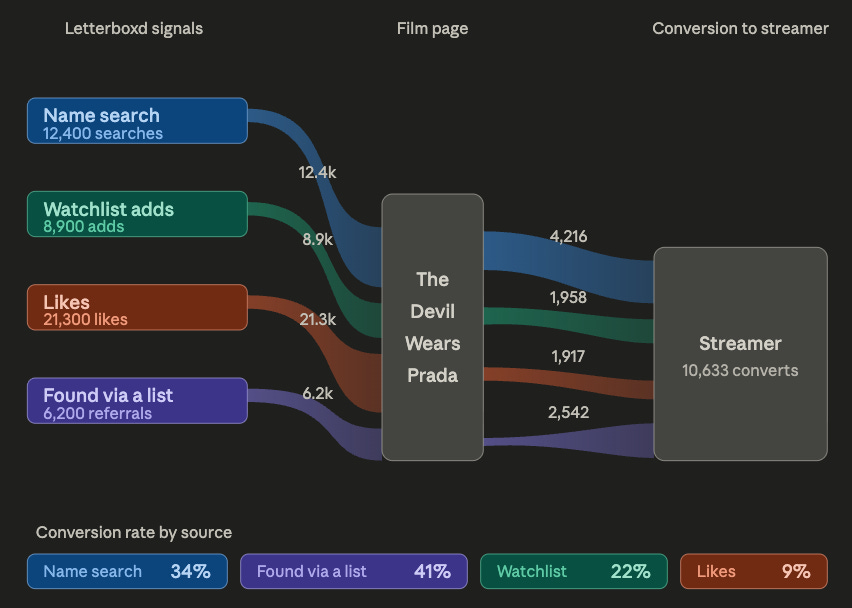
What is the conversion rate from discovery to platform acquisition?
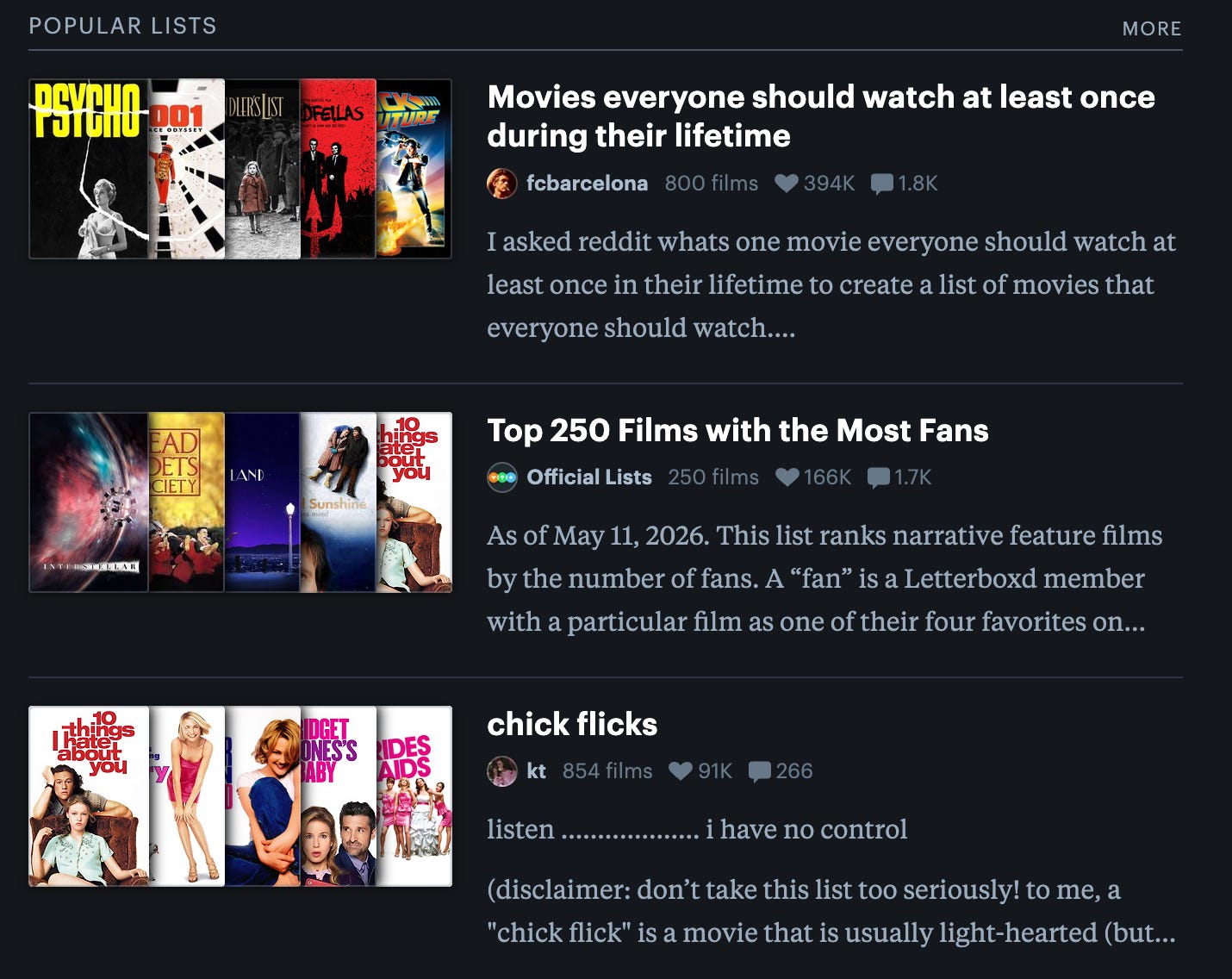
Letterboxd can, in theory, track exactly that. And that number, the actual downstream conversion a title drives to a streaming platform, is the metric that should be restructuring how creators are compensated.
Right now, residuals are calculated on models that predate streaming entirely. They do not reflect the reality that a film like The Devil Wears Prada is still actively doing discovery work almost two decades after release. Every time someone adds it to a “Chick Flicks” list that gets shared and followed and interacted with, that is essentially free marketing for whoever currently holds the license.
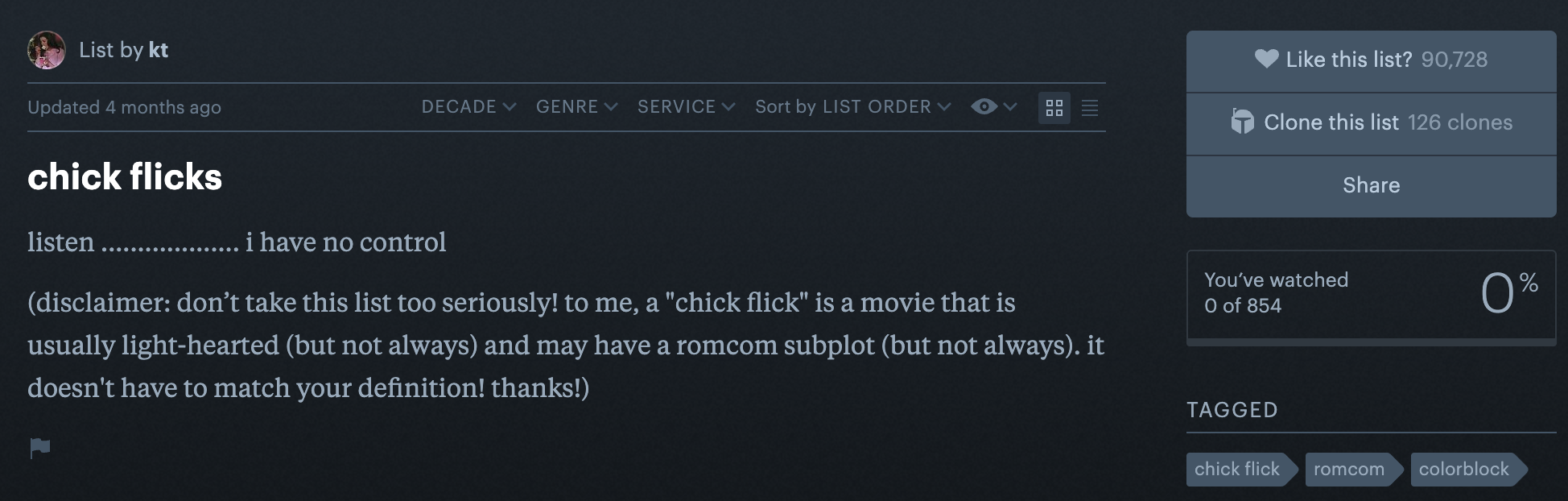
The creator sees none of it. The streamer benefits invisibly.
The Engagement Metrics That Actually Matter
I want to be specific about what a creator should want from a platform like Letterboxd, because not all engagement is created equal.
“Likes” on a film page or list are a weak signal. They reflect sentiment, but sentiment does not pay residuals and does not tell you much about what drove the watch. Total list appearances are more interesting, but only as a starting point.
The number that actually matters is the engagement quality of those lists: how many people follow them, how often those followers convert to actual views, and how quickly those numbers move after a title resurfaces in conversation.
Growth rate matters more than raw totals. A niche film that appears on 50 highly engaged lists and drives a measurable conversion spike to its host platform is telling a more valuable story than a blockbuster that sits on 5,000 lists nobody actively uses.
The signal is in the velocity, not the volume.
What that means practically: if you are a filmmaker, showrunner, or studio executive sitting across a licensing negotiation from a streamer, Letterboxd data could be the closest thing to an independent audit of your title’s discovery value that currently exists anywhere in the ecosystem. Not because Letterboxd is perfect or comprehensive, its 26 million users represent a small fraction of the total viewing public, but because those 26 million are disproportionately influential. They are the people whose lists get followed, whose recommendations get trusted, whose engagement actually moves something.
Below I’ve outlined a diagram to visualize the different avenues Letterboxd can provide to drive conversions based on a title.
The “Similar Films” Section Is VERY Underrated
One piece of the Letterboxd interface that gets overlooked is the “similar films,” “themes,” and, “nanongenres” categorization. This section is underrated because it helps provide signal on a few fronts.
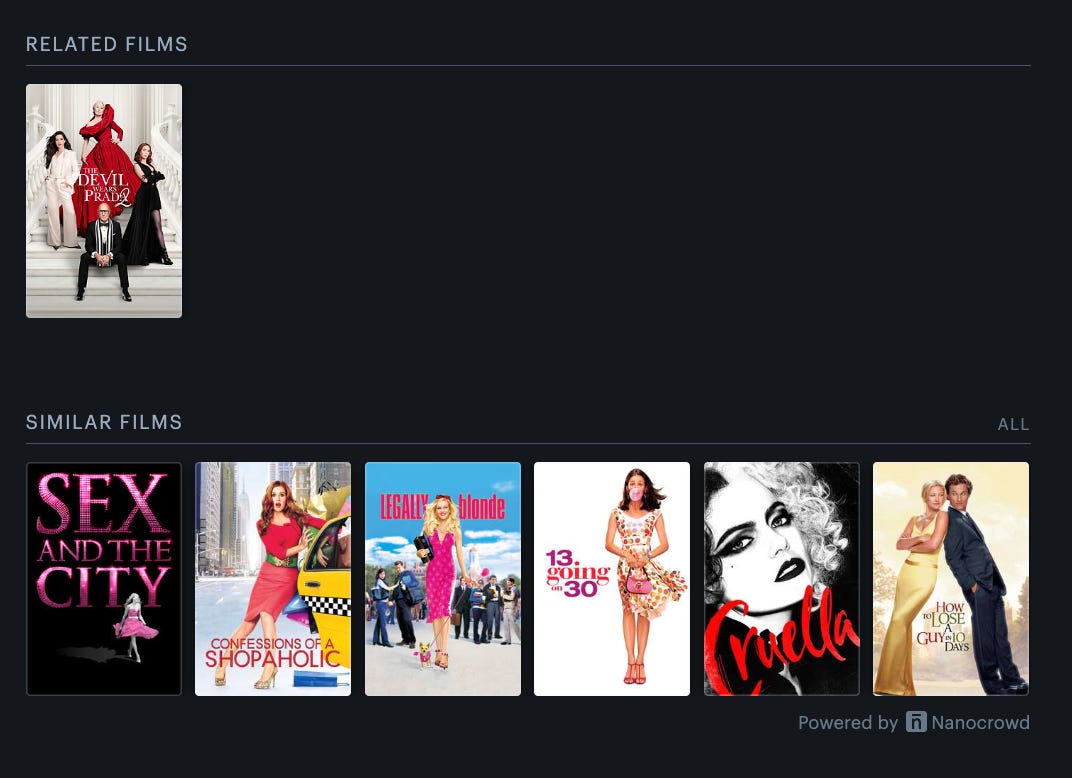
From a content discovery lens (aside from user sentiment), what is the key ingredient that convinced a user to watch? While there’s user intent, such as “liking” a film or “saving it” to a list, the action to convert to the streamer that’s licensed the film is the key driving factor, and while it’s almost never, “one” factor, it’s a healthy indicator.
What made the viewer decide to watch?
Was it a particular actor?
Was it a particular theme?
Was it a specific genre?
Below I’ve broken down the insights that can be gathered from each section:
1. All Similar Films
Titles that appear under “similar films” are populated by a propensity score which is calculated based on how many common “tags” a title shares with The Devil Wears Prada.
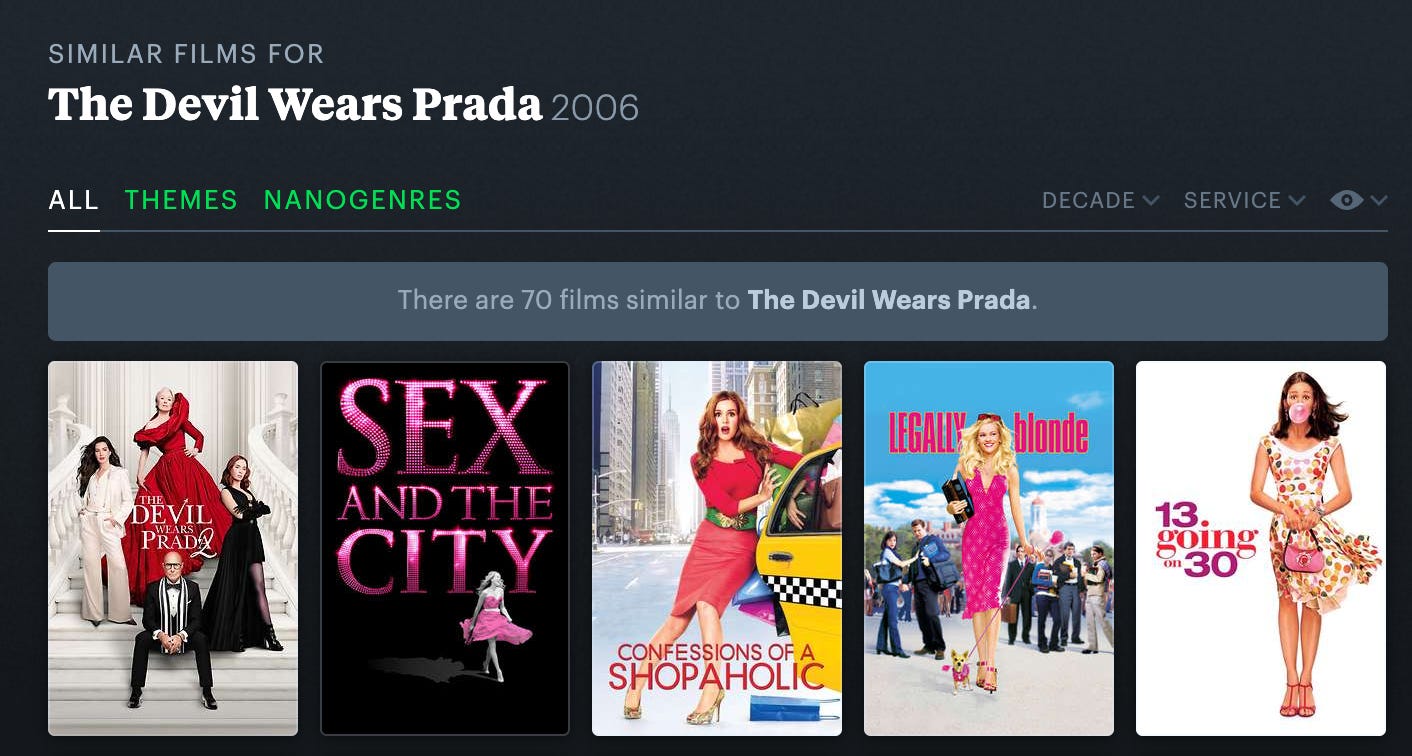
The Insight: In an ideal data environment, you would see not just which films appeared in that rail, but which specific tags they share with the title and how strongly each one weighted the score. Actors, themes, genres, tone: the full taxonomy the algorithm used to draw the comparison.
Three distinct insights emerge from looking at this layer:
For positioning: Tag-level visibility tells you how a film is being placed among its peers, not by the creative team’s intention, but by the cold logic of the platform itself. Filmmakers carry a precise vision of how their work should be perceived. The algorithm and the audience carry their own. Where those three readings converge is validation. Where they diverge is information worth having.
For conversion: Tag data opens the door to a more structural question: is there a specific attribute, a shared actor, a recurring theme, a tonal register, that consistently correlates with a viewer actually choosing to watch? If one tag keeps surfacing across the titles that get clicked, that pattern is not noise. That is signal, and signal at this level is rare enough to be genuinely valuable.
For the broader picture: Together, these two lenses reframe what a content rail actually is. Not just a row of thumbnails generated by an invisible hand, but a map of how a title exists in relation to everything around it. Understanding that map, who drew it, by what logic, and what it is quietly telling the audience about your film, is its own form of competitive intelligence.
2. Themes
Below you’ll see how the “tags” are categorized by themes so a viewer can view other films that share the same themes as The Devil Wears Prada.
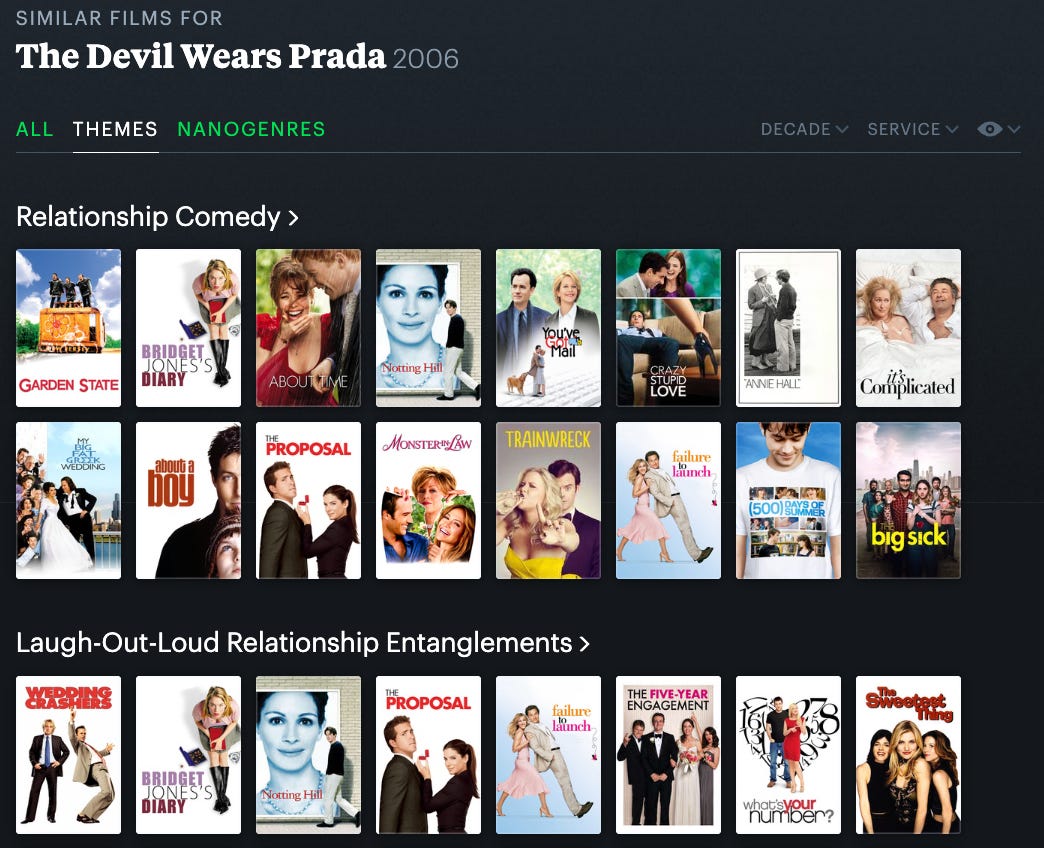
The Insight: Themes operate at a different register than genre. Where genre describes the container, theme describes what is actually inside it: the overarching tone, the emotional core, the idea the story keeps returning to. A genre label tells you a film is a romantic comedy.
A theme tells you it is about the specific exhaustion of wanting something you are not sure you deserve.
Three distinct insights emerge from looking at this layer:
For creatives: Themes reveal the gap between intention and reception. A filmmaker has a vision for how their work should land. The algorithm and the audience have their own. Seeing which themes surface in the films placed alongside yours is a way of reading that gap honestly, understanding not just how the film was made, but how it settled in the minds of the people who watched it.
For buyers and sellers: Themes reframe a single title as part of a portfolio of reception. If a particular emotional core keeps appearing across titles that audiences are gravitating toward, that is not coincidence. That is a market signal. Take “laugh-out-loud entanglement” as an example. On the surface it lives inside the romantic comedy bucket, but it says something more precise: the audience wants to laugh, and they want it to feel genuinely romantic, not just categorically so. That granularity points toward an appetite in the market that shows up in behavior before anyone has named it.
For the broader picture: Themes are ultimately the most useful lens for packaging, the layer at which a film communicates its identity to the world. They answer the question not just of what a title is, but of what it means to the people who chose it.
The distinction between themes and nanogenres is ultimately a distinction between packaging and anatomy. Themes tell you how a film faces the world. Nanogenres tell you what it is made of.
3. Nanogenres
Then a viewer can view a section called “nanogenres” which categorizes films at a level deeper by individual traits of the film. Nanogenres are where the tags gets surgical.
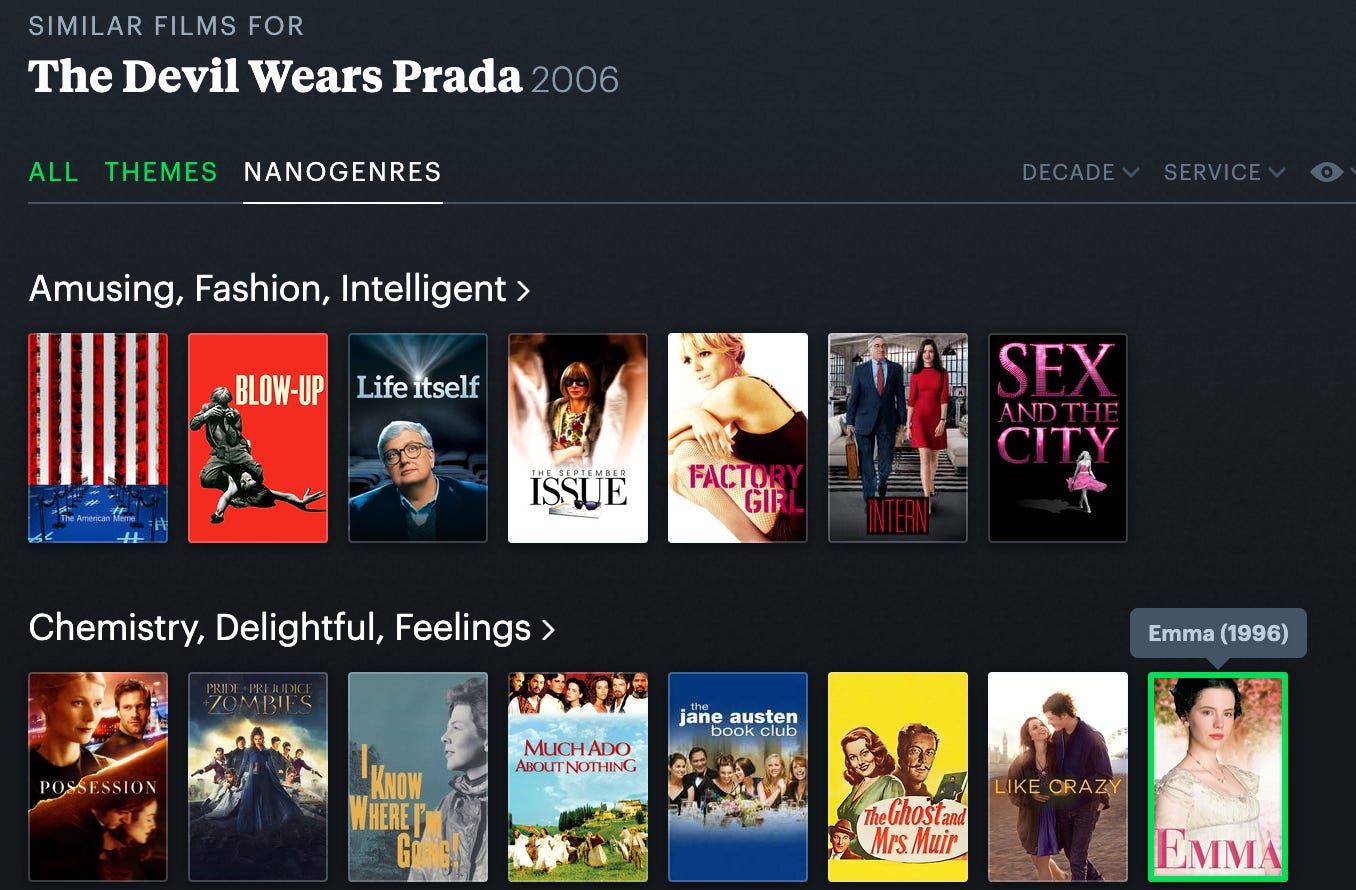
The Insight: Nanogenres are where the taxonomy gets surgical. Hyper-specific micro-categories built around exactly what appears on screen or how a viewer emotionally responds, they sit a full layer beneath themes in specificity. A theme tells you a story is built around wit and romantic tension. A nanogenre tells you there is fashion in the frame, that the chemistry reads as intelligent, that the humor never tips into cheap.
Three distinct insights emerge from looking at this layer:
For the viewer: The appetite is real, even if the language is not. Nobody opens a streaming app consciously searching for “intelligent chemistry with fashion.” But that combination keeps pulling people back anyway, expressed through behavior rather than words.
For creatives: Nanogenres function less as a blueprint and more as a mirror. You would not engineer a film around a checklist of attributes. But in the aftermath of analysis, patterns surface that even the creator may not have consciously intended, specific textures that kept resonating, combinations that gave the work genuine pull. Think of it as a scene-level audit of your own writing.
For buyers and sellers: Where themes help position a film within the broader market, nanogenres add precision to the question of what a title actually is and who it is actually for. That granularity matters when licensing decisions hinge on more than a genre label.
The distinction between themes and nanogenres is ultimately a distinction between packaging and anatomy. Themes tell you how a film faces the world. Nanogenres tell you what it is made of.
The Bigger Argument at Play
The data has always existed. The question is who it belonged to.
Streamers have known for years which titles drive subscriptions, which ones keep households from cancelling, and, which discovery pathways convert casual browsers into committed viewers. That intelligence stays inside the platform.
Creators, the people who made the thing that is quietly doing all that work, have operated largely on instinct, reputation, or whatever their representation could negotiate in the dark.
Letterboxd changes the geometry of that problem, modestly but meaningfully.
It is not a perfect dataset. Its 26 million users skew devoted and discerning, which means the signal is sharpened rather than representative. But that selectivity is the point. What Letterboxd captures is not passive consumption. It is active curation, a community of people building lists, following recommendations, and converting to platforms to actually watch something. That chain of behavior, from discovery to intent to action, is the closest thing to an independent audit of a title’s discovery value that currently exists outside a streamer’s walled garden.
Each data point Letterboxd offers is a different answer to the same question: what does this film actually mean to the people who chose it?
That question is not just creative. It is economic.
Creatives who learn to read audience data as both creative signal and contractual leverage will negotiate from a position that those who ignore it simply cannot. That advantage, however, compounds most when it moves beyond individual deals. If guilds and unions were to build formal benchmarks around engagement metrics, conversion velocity, list growth, downstream traffic to licensed platforms, the residuals conversation gains something it has lacked since streaming made the old models obsolete: evidence.
An organic funnel is still a funnel. A film that is twenty years old and still actively pulling new viewers toward a platform it has no formal relationship with is still doing work. That work has value.
The industry has just never had the infrastructure, or the incentive, to account for it honestly.
That infrastructure may be closer than it appears. The community already knows what it cares about. The data is already there. The gap that remains is not technical. It is a question of will.